

If you’ll allow me a sensible chuckle, I believe that overusing the word impact often dilutes its, well, impact. A document saturated with impacts starts to look like a field of craters rather than a polished publication, but the careful use of ‘effect’ and ‘affect’ in its place can smooth things over. Here is a condensed guide for choosing the right word.

I like to save ‘impact’ for situations where one thing is literally or metaphorically hitting another thing to give it its proper gravitas. In its place, I use ‘effect’ when I need a noun and ‘affect’ when I need a verb. Herein lies the problem: it’s so tempting to choose ‘impact’ because it can be used as both a noun and a verb (and some other things), so you don’t have to know the difference.
If you’re ready to move on from ‘impact’ but you’re not confident identifying your nouns and verbs, here is an easy way to tell them apart.
Nouns (things) are usually accompanied by ‘a’, ‘an’ or ‘the’ (called an article). So, if you’re tempted to write ‘an impact’ or ‘the impact(s)’, it’s a noun and you can choose ‘effect’ instead: ‘an effect’, ‘the effect(s)’. There can be an adjective between the article and the noun, so watch for things like ‘the immediate effects’ or ‘a general effect’. The article is the giveaway.
Verbs (actions) are usually transformed in some way depending on the tense, or conjugated. ‘Affecting’, ‘affected’, ‘affects’, ‘will affect’, ‘has affected’, ‘will be affecting’, those kinds of things. So, if you’re about to write ‘impacting’, ‘impacted’, ‘impacts’, ‘will impact’ and so on, choose ‘affect’ instead. If the tense you are writing in changes the word, it’s probably the verb, affect.

There are exceptions to these, of course, because that’s English. But, knowing these general tell-tale signs will increase your confidence telling them apart. Once you have some practice using these guidelines, spotting them will become much more vibes-based. If it feels more like a thing, it’s probably a noun. If it feels more like an action, it’s probably a verb.
Sometimes it’s sort of both. If you read the phrase ‘has an effect on’, you can see that ‘an effect’ (noun), complete with an article, is forced to perform an action like a verb; it has become a sort of phrasal verb by adding ‘has’ and ‘on’. So, you guessed it, you can just use the verb ‘affect’ instead in any tense you like.
‘It had an effect on me’ becomes ‘it affected me’
‘it has an effect on the whole business’ becomes ‘it affects the whole business’
‘it will have an effect on your results’ becomes ‘it will affect your results’.
Even better, you can do this with ‘has an impact on’ as well: just ‘affects’ is much neater.
It also makes your writing more active and in line with the principles of plain English. Using nouns as verbs like ‘had an effect on’ and ‘had an impact on’ subtly forces your reader to do more grammatical calculation to understand your meaning; ‘affect’ is much faster and easier to comprehend. It can cut down your word count, too.
It’s a bit of an art knowing when to use ‘impact’ instead of ‘effect/affect’, and you have to exercise your authorial or editorial judgement. Limiting its use increases its weight, so I reserve it for when something is actually striking another thing, literally or otherwise. When I’m deciding, I find myself visualising the poster for the 1998 film Deep Impact; I compare the titular deep impact against the intended meaning and general vibe of the use of ‘impact’ in the text, and if I find it wanting, I switch it to ‘effect’ or ‘affect’.
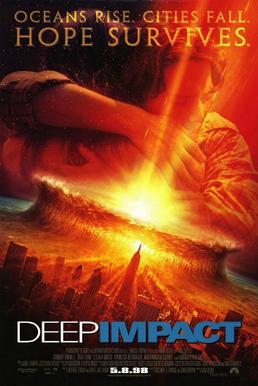
Plus, reading ‘impact’ over and over can become tedious. Avoiding excessive word repetition is an important part of improving the appeal of your writing.
As with many things grammatical, using ‘effect’ and ‘affect’ correctly is a great way to communicate to your reader, subconsciously or not, that you know what you’re talking about. Be it for business partners, colleagues, grant application boards, markers, journal editors or just your friends and family, it will affect their perception of your writing, and by extension, you. Don’t underestimate it’s imp- effect.
 Rosemary Mulray
Leave a comment